Introduction
Most products are designed by engineers who never run the machines that make them. Design teams optimize for function, aesthetics, and performance—but the people operating the CNC spindles, die casting machines, and assembly lines know what actually gets a part out of a mold cleanly or off a fixture without rework. This gap between design intent and production reality is where cost overruns, delays, and quality failures are born.
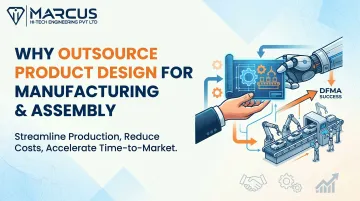
Outsourcing product design for manufacturing and assembly is often misunderstood as simply cutting costs. Its real value lies in closing the gap between what a design says and what a factory can reliably produce at scale.
When a manufacturing partner reviews or co-develops your design before tooling begins, they bring process-specific knowledge that most internal design teams never accumulate. That knowledge is what separates a smooth production ramp from months of troubleshooting after tooling is already sunk.
What follows covers the specific operational advantages this approach delivers—reduced tooling iterations, lower scrap rates, faster ramp-up—and where it matters most for OEMs and Tier-1 suppliers managing tight lead times across automotive, aerospace, and industrial programs.
TL;DR
- Outsourcing DFMA means a manufacturing partner co-develops your design for repeatable, cost-effective production before tooling begins
- Over 70% of production cost is locked in during the design phase; changes after tooling can cost 10–100x more
- Key advantages: lower unit and tooling costs, faster time-to-market, and quality built into the process from the start
- Internal teams optimize for function; manufacturing partners optimize for process capability — you need both
- Earlier involvement = higher impact on cost, quality, and schedule
What Is Product Design for Manufacturing & Assembly?
Design for Manufacturing and Assembly (DFMA) is the practice of designing a product with explicit consideration for how it will be built, assembled, and produced at scale — not just how it functions. It combines two complementary disciplines:
- DFM (Design for Manufacturing) — focuses on making individual parts easier and cheaper to produce
- DFA (Design for Assembly) — reduces assembly complexity by minimizing part count and simplifying joining methods
DFMA typically sits between initial concept/CAD and production release. It's most powerful when applied before tooling is finalized or components are locked. Outsourcing DFMA means engaging a manufacturing partner early in this phase—not to receive a design review document, but to arrive at a production-ready design that reduces scrap, shortens lead times, and reaches the assembly floor without costly surprises.
Reaching that production-ready outcome reliably requires more than engineering judgment. Certified manufacturing partners like Marcus apply structured processes — APQP (Advanced Product Quality Planning), PPAP (Production Part Approval Process), and FAIR (First Article Inspection Report) — during DFMA reviews. These protocols form the framework through which design decisions are validated against actual production capability before a single part is made.
Key Advantages of Outsourcing Product Design for Manufacturing & Assembly
The advantages below are grounded in operational outcomes that procurement leads, engineering managers, and operations heads track. Each directly impacts cost, speed, quality, or risk — and the mechanism behind each is specific, not theoretical.
Manufacturing-Informed Design That Reduces Production Costs
When a manufacturing partner reviews or co-develops a design, they apply process-specific knowledge that internal design teams rarely have: tooling behaviour, material flow, cycle time, and fixture constraints. This knowledge makes designs cheaper to produce.
How this works in practice:
A manufacturer reviewing a design for die casting, CNC machining, or sheet metal will flag features that add machining time, require extra tooling setups, or create high scrap rates. They suggest geometry changes with direct cost impact before a single tool is cut.
Why this advantage matters:
Research shows that over 70-80% of a product's production cost is determined during the design phase, meaning procurement can only negotiate the remaining cost margin. Early design review by a manufacturer is the most powerful cost lever available.
The "Rule of 10" illustrates this clearly: a design flaw costs nearly nothing to fix at the concept phase, but 10-100x more after tooling is cut. DFMA outsourcing functions as financial risk mitigation — the cost of prevention is a fraction of the cost of correction.
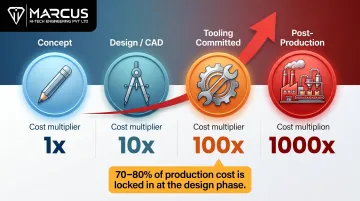
Marcus applies industry-standard DFM processes including APQP and PPAP to validate design decisions against real production capability before commitment. With a dedicated tool room featuring simulation capabilities and 45+ years of manufacturing experience, the company identifies cost-driving design features — such as zero-draft walls, variable wall thickness in die cast parts, or impossible tolerances on non-critical features — before tooling investment.
KPIs impacted:
- Unit production cost
- Tooling cost
- Material utilisation rate
- Scrap/rework rate
- Cost of engineering changes post-production release
This matters most in:
- High-volume production, where per-unit savings compound across runs
- Complex geometries in die casting or precision CNC
- Multi-material assemblies where part count and join methods drive assembly labour costs
Faster Time-to-Market Through Design-to-Production Continuity
When the manufacturer is involved in the design phase, they arrive at production already familiar with the product, its requirements, and potential process risks. There is no downstream handoff of a frozen design. This eliminates the handoff friction that typically delays production ramp-up.
How this plays out operationally:
Tooling planning, material sourcing, supplier qualification, and production scheduling begin in parallel with design finalisation rather than sequentially after it. Catching features that cannot be produced as designed before tooling is cut eliminates T1 tooling trial failures that routinely add weeks to a program.
Concurrent engineering programs achieve development cycle time reductions of 40-60% and reduce engineering change orders by 50% in early production. When design and manufacturing are treated as separate, sequential activities, critical tacit knowledge about design intent is lost in the handoff. When the manufacturer is involved early, that knowledge is captured and retained.
Research from INSEAD and Wharton shows that engineering change orders (ECOs) account for one-third to one-half of total engineering capacity in many projects, with lead times ranging from several weeks to over a year despite actual processing time of under two weeks. Early DFMA involvement prevents this bottleneck by resolving issues before tooling commitment.
KPIs impacted:
- NPI cycle time
- Time-to-market
- Tooling trial iterations (T1/T2/T3)
- Production ramp-up speed
- ECO volume post-release
Programs where this delivers the clearest return:
- New product introductions with fixed competitive launch windows
- Automotive and EV programs where APQP timelines are contractually rigid
- Projects with first article inspection (FAIR) requirements, where design-production alignment is subject to audit
Quality Designed In, Not Inspected In
Outsourcing to a certified manufacturing partner means quality is embedded at the design stage through structured review processes, rather than caught through inspection after production has already generated non-conforming parts.
Certified partners apply APQP, PPAP, and FAIR protocols as part of the design-to-production workflow. These are not add-ons — they are the framework through which design decisions are validated against quality requirements before parts are made.
Quality by inspection finds defects after the fact. Quality by design prevents them through process validation. DFMA outsourcing to a certified partner is the mechanism for the latter.
Partners holding certifications like IATF 16949:2016 operate under documented quality management systems that govern design reviews, process capability studies, and in-process controls. This provides OEMs with audit-ready evidence of design validation.
For automotive, aerospace, healthcare, and EV customers, traceability and compliance are contractual requirements — not optional.
Marcus is certified to IATF 16949:2016 and ISO 9001, applying APQP, PPAP, and FAIR protocols from design validation through production. For aerospace components, the company provides 100% CMM inspection with full dimensional reports and material certificates per AS9100 requirements. This structured approach ensures quality is built into the design, not added through inspection.
Industry research shows that quality-related costs consume 15-20% of sales revenue, with some organisations reaching 40%. DFMA reduces these costs by preventing defects rather than detecting them.
KPIs impacted:
- First-pass yield
- Defects per million opportunities (DPMO)
- Rework and scrap rate
- First article acceptance rate
- Cost of poor quality (COPQ)
- Audit pass rate
This is most critical in:
- Regulated industries (automotive, aerospace, medical/healthcare) where design validation documentation is a contractual requirement
- High-complexity assemblies where tolerance stack-up across multiple parts creates systemic quality risk if not managed at the design stage
What Happens When Product Design Is Disconnected from Manufacturing
When design and manufacturing are treated as separate, sequential activities, the factory receives a "frozen" design that was never pressure-tested against production constraints. The result is a set of predictable, costly failure modes that compound the further along production goes:
Tooling rework and T1 trial failures driven by features that were never validated for the production process—zero-draft walls, variable wall thickness in die cast parts, impossible tolerances on non-critical features.
Cost overruns from late-stage engineering changes. Tooling modifications typically cost $38,000 to $100,000 per change. Once tooling is cut, every revision resets the clock on launch timelines.
Schedule slippage and missed launch windows when tooling trials fail — cascading into delayed customer commitments and lost market opportunities.
Elevated scrap and defect rates in early production when process capability issues emerge that integrated design review would have caught before tooling was ever commissioned. Scrap and rework without concurrent engineering practices can be up to 75% higher than with integrated design-manufacturing workflows.
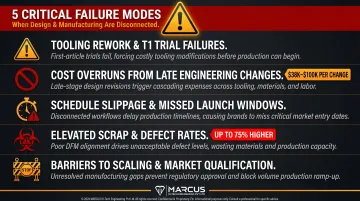
Barriers to scaling and market qualification when incomplete or unvalidated design-production documentation blocks PPAP submission, regulatory approval, or new customer onboarding.
How to Get the Most Value from an Outsourced DFMA Partnership
DFMA outsourcing delivers its highest value when the manufacturing partner is engaged at the concept or early CAD stage—not after a design has been finalised or a mould quotation has been requested. The earlier the engagement, the larger the cost and schedule impact.
A structured handoff sets the foundation for a productive review. At minimum, share:
- CAD files (STEP/IGES format) and a current bill of materials
- A clear list of critical-to-function dimensions versus negotiable tolerances
- Explicit "must-haves" versus "nice-to-haves" so the manufacturer can focus review effort where it counts
Treat the process as iterative, not a one-time checklist. Design review findings should drive documented changes, and those changes should be validated against production capability in an ongoing feedback loop. Boothroyd Dewhurst case studies across 170+ published examples show average total cost reductions of approximately 50%, with part count reductions of 40–85% typical when DFMA is applied this way.
Choosing a partner with the right infrastructure makes this iteration practical rather than theoretical. Marcus brings in-house tool design, simulation, and mould manufacturing under one roof, which means manufacturability issues can be identified and resolved before tooling is finalised. With certifications in IATF 16949:2016 and ISO 9001, Marcus follows structured DFM, APQP, PPAP, and FAIR protocols to ensure design validation occurs across its end-to-end manufacturing solutions—from die casting and CNC machining to sheet metal and assembly.
Conclusion
The case for outsourcing product design for manufacturing and assembly is not about reducing headcount or cutting design budgets—it's about bringing process reality into the design phase when changes are still cheap, fast, and low-risk.
The three advantages compound over time and across programs when you treat your manufacturing partner as a long-term collaborator rather than a downstream vendor:
- Cost-optimised designs that eliminate expensive late-stage engineering changes
- Faster time-to-market through parallel design and process planning
- Quality built in from day one, not inspected in after the fact
DFMA outsourcing is an ongoing strategic practice: each program builds shared process knowledge between the OEM and the manufacturing partner. Over time, that shared knowledge compounds—tighter tolerances get hit more reliably, tooling costs drop, and new product launches move faster because the groundwork is already in place.
Frequently Asked Questions
What is the difference between DFM and DFMA?
DFM (Design for Manufacturability) focuses on making individual parts easier and cheaper to produce, while DFA (Design for Assembly) focuses on reducing the complexity of joining parts together. DFMA combines both disciplines and is applied when a product involves multiple components that must be produced and assembled efficiently.
When should a manufacturing partner be brought into the product design process?
The highest impact comes from engagement at the concept or early CAD stage—before tooling decisions are made. At a minimum, a manufacturing partner should review the design before any tooling is released or production materials are committed, as design changes become significantly more expensive after that point.
Does outsourcing product design mean giving up control over my intellectual property?
Reputable manufacturing partners operate under NDAs and formal IP protection agreements before any design files are shared. OEMs retain full ownership of their designs; the manufacturing partner's role is to provide process input, not to take ownership of the product concept or geometry.
Is DFMA outsourcing only relevant for high-volume production?
DFMA review delivers value at any volume—even for low-volume or prototype runs, catching a design flaw before tooling or fixturing is built prevents disproportionate cost and delay. The financial return is highest at volume, but the risk reduction benefit applies at all scales.
What certifications should I look for when choosing a manufacturing partner for design support?
IATF 16949:2016 and ISO 9001 are the key benchmarks, particularly for automotive, aerospace, and precision industrial applications. Partners who follow structured processes like APQP, PPAP, and FAIR provide documented evidence that designs have been validated against production capability. This is essential for regulated industries and global OEM supply chains.
How does outsourcing product design affect time-to-market compared to keeping design in-house?
When the manufacturing partner is involved from the design stage, tooling planning, supplier qualification, and production scheduling run in parallel with design finalization rather than sequentially after it. This compresses NPI timelines, and eliminating tooling trial failures (T1 rework) alone can recover weeks on a product launch schedule.