Introduction
At some point, most engineering leads and procurement managers hit the same wall: internal assembly capacity can't keep pace with demand, costs are climbing, or a new product launch is exposing gaps in in-house capabilities. For companies in automotive, EV, aerospace, electronics, and industrial manufacturing, the decision to outsource assembly directly affects costs, lead times, and supply chain complexity.
Product assembly outsourcing means handing off the physical build and assembly of your product (or its sub-components) to a specialized third-party manufacturer. According to an industry analysis by Allied Market Research, the global electronic contract manufacturing market reached $649.1 billion in 2025 and is projected to hit $1,361.5 billion by 2033 — reflecting the scale at which manufacturers are choosing external partners over internal production.
This article walks through what outsourcing involves, the business case behind it, how the engagement works step by step, what to look for in a partner, and when it makes sense, and when it doesn't.
TL;DR
- Product assembly outsourcing transfers the physical build of your components or finished products to a certified third-party manufacturer
- Key benefits include cost reduction, specialized equipment access, faster time-to-market, and simplified supply chains
- The process covers scoping, partner qualification, PPAP/FAIR trial builds, and governed volume production
- Choose partners based on certifications (IATF 16949, ISO 9001), vertical integration, scalability, and IP protection
- Outsourcing isn't suitable for extremely tight tolerances, low volumes, or core proprietary technologies
What Is Product Assembly Outsourcing?
Product assembly outsourcing is a contract arrangement where an external manufacturer takes your design intent and produces the assembled output at their facility using their equipment and workforce. The output can be a sub-assembly, a finished component, or a complete electro-mechanical unit.
Sub-Assembly vs. Full Product Assembly
| Type | Scope | Typical Use Case |
|---|---|---|
| Sub-assembly outsourcing | Specific modules that feed into your final product | Automotive OEMs outsourcing instrument panels or battery housing modules while keeping final vehicle assembly in-house |
| Full product assembly outsourcing | Entire build process, from component procurement through final testing and packaging | Products where internal assembly capacity is limited or cost-prohibitive |
Most industrial manufacturers start with sub-assemblies. This approach allows companies to test the partnership, validate quality systems, and maintain control over final integration before committing entire product lines.
OEM vs. Contract Manufacturing: Clarifying the Terms
These terms overlap but mean different things:
- OEM (Original Equipment Manufacturer) owns the product design and brand
- Contract manufacturing is the production model where a third party builds the OEM's product
- Outsourcing is the strategic decision to use external resources instead of internal capacity
For procurement officers, the practical distinction is this: when you outsource assembly, you remain the OEM and retain IP ownership. The contract manufacturer executes your specifications under a defined quality agreement.
Why Companies Outsource Product Assembly
Cost Reduction
Cost reduction drives most outsourcing decisions. Flex reported a case study where one energy technology OEM achieved a 40% reduction in production costs and a 500% increase in production volume through manufacturing outsourcing.
Cost savings come from three main sources:
- Converts fixed capital costs (factory ownership, specialized equipment) into variable costs — you pay only for capacity used
- Eliminates direct labor, QA staff, supervisors, and HR overhead tied to a production workforce
- Frees up facility space previously locked into assembly lines, staging areas, and inspection stations
For parts requiring multiple processes, single-source manufacturing can reduce costs by 15% to 25% by eliminating redundant vendor margins and inter-vendor shipping.
Strategic Focus
According to McKinsey research, "The United States is most competitive in R&D- and design-based activities but losing ground in scale-based and learning-curve activities."
If your core competency is product design, R&D, or sales, managing a production floor is a distraction. Outsourcing frees internal teams to focus on:
- Product innovation and next-generation development
- Customer acquisition and market expansion
- Revenue-generating activities rather than operational bottlenecks
The same Flex case study noted that redirecting resources from manufacturing to market development helped the customer achieve a 3x increase in stock price and expand into 61 countries.
Supply Chain Consolidation
Managing multiple tier-2 and tier-3 suppliers for different assembly capabilities adds cost and complexity at every handoff. Consolidating to a single partner reduces:
- Purchase order overhead and vendor coordination
- Quality accountability across handoff points
- Lead time delays from inter-vendor logistics
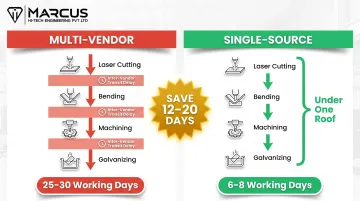
For a part requiring four processes, single-source manufacturing can save 12 to 20 working days by eliminating transit and scheduling delays between vendors. A galvanized steel bracket requiring laser cutting, bending, machining, and galvanizing drops from 25-30 working days via multi-vendor to 6-8 working days via single-source.
Scalability
Assembly outsourcing lets production volumes flex with demand — no idle equipment, no excess headcount during slow periods. The risk shifts to the contract manufacturer.
This matters most in high-volatility sectors:
- McKinsey projects worldwide EV demand will grow sixfold from 2021 through 2030, from 6.5 million to roughly 40 million annual units
- The Flex customer absorbed 25% quarterly demand swings with confidence through outsourced manufacturing
For OEMs in sectors like EV, aerospace, or consumer electronics, this flexibility can be the difference between capturing a market window and missing it.
Access to Specialized Expertise and Equipment
Contract manufacturers invest in advanced machinery and process certifications that individual OEMs cannot justify for a single product line:
- High-tonnage die casting machines (40T to 2500T)
- Multi-axis CNC machining (5-axis simultaneous)
- Automated assembly cells with robotic integration
- Precision measurement equipment (CMM, inline inspection)
Approximately 60% of consumer electronics production is currently outsourced, compared to just 20% of regulated industrial and healthcare production — suggesting many manufacturers in these sectors are still absorbing capability costs they could transfer to a specialist partner.
How the Product Assembly Outsourcing Process Works
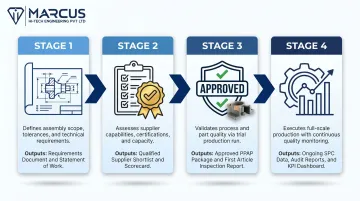
The outsourcing process moves through structured stages: requirement definition, partner qualification, trial builds, and ongoing quality governance. Each stage has defined inputs, outputs, and decision gates.
Scoping and Requirements Definition
The process begins with the OEM providing detailed product specifications:
- Engineering drawings with GD&T callouts
- Tolerance requirements and critical dimensions
- Material specifications and approved supplier lists
- Regulatory or certification requirements (UL, FDA, aerospace standards)
- Volume forecasts and delivery schedules
Design for Manufacturability (DFM) review occurs at this stage. DFM identifies potential manufacturing issues early — reducing costly rework, shortening lead times, and improving production yield before tooling investment.
Partner Evaluation and Qualification
OEMs evaluate potential partners using structured criteria:
- Capability audits — Verify equipment capacity, process capabilities, and vertical integration scope. Can the partner handle all required processes in-house, or will they subcontract portions?
- Quality certifications — IATF 16949 builds on ISO 9001 with automotive-specific requirements: defect prevention, PPAP compliance, and supply chain traceability. A partner holding IATF 16949 has demonstrated more rigorous quality maturity.
- Capacity and geographic footprint — Assess production volume, lead time commitments, and scalability. Geographic proximity matters for frequent design iterations or just-in-time delivery.
- IP protection agreements — NDAs must be signed before sharing detailed design files. The U.S. SEC has issued formal guidance on IP theft risks when designs are shared with third-party manufacturers.
Trial Build and Approval
Before committing to volume production, most industrial outsourcing engagements include validation steps:
PPAP (Production Part Approval Process) defines 18 required elements proving a supplier can consistently reproduce quality parts — covering design documentation, DFMEA, process flow diagrams, PFMEA, control plans, dimensional results, and sample parts.
FAIR (First Article Inspection Report) provides objective evidence that all engineering and specification requirements are understood, verified, and documented. Per AS9102, FAIR is standard in aerospace, defense, and space programs.
The OEM's engineering team reviews samples, conducts dimensional verification, and approves the partner to proceed to volume production.
Volume Production and Quality Governance
Ongoing production is governed through:
- Inline inspection: Real-time quality checks during production to catch defects before they propagate
- Statistical process control (SPC): Monitoring process variation to maintain capability and prevent drift
- Periodic audits: Scheduled assessments of quality system compliance and process adherence
- Non-conformance escalation: Defined procedures for reporting, investigating, and correcting quality issues
The OEM remains responsible for final product quality and should maintain a defined quality agreement with clear acceptance criteria and corrective action protocols.
What to Look for in an Assembly Outsourcing Partner
Certifications and Quality Systems
Quality certifications signal process maturity and reduce qualification risk.
IATF 16949:2016 is the automotive-sector-specific QMS standard. It adds automotive-specific requirements beyond ISO 9001:
- Product safety management with documented multi-level approvals
- Mandated use of APQP, PPAP, FMEA, MSA, and SPC
- Sub-tier supplier management with cascading requirements
- Defect prevention emphasis rather than reactive corrective action
ISO 9001 is the globally recognized baseline for quality management systems, applicable to any organization regardless of industry.
Partners holding both certifications—and following structured processes like APQP, PPAP, and FAIR—remove a significant portion of qualification risk for the OEM.
For instance, Marcus holds both IATF 16949:2016 and ISO 9001 certifications and implements industry-standard processes including DFM, APQP, PPAP, and FAIR across its operations.
Capability Breadth and Vertical Integration
A vertically integrated partner who handles multiple manufacturing steps under one roof delivers measurable advantages:
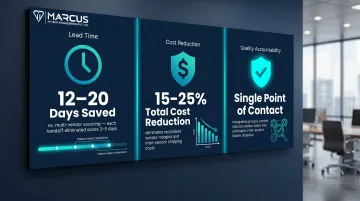
Lead time compression: Each handoff between vendors adds 3 to 5 working days. For a part requiring four processes, single-source manufacturing saves 12 to 20 working days.
Cost reduction: Eliminating redundant vendor margins and inter-vendor shipping reduces total cost by 15% to 25%.
Quality accountability: Single point of contact eliminates blame disputes between vendors. Integrated process control means teams understand how their work affects the next step, reducing defect rates.
Look for partners who can handle die casting, CNC machining, sheet metal fabrication, surface treatment, and assembly—not just one process. This breadth reduces handoffs, compresses timelines, and simplifies accountability.
Scalability and Flexibility
Capability breadth only delivers value if the partner can scale with your demand. Ask specifically how they manage capacity during surges:
- Do they maintain buffer capacity or rely on overtime and weekend shifts?
- Can they accommodate both prototype volumes (10-100 units) and high-volume production (10,000+ units) without requiring you to switch vendors at scale?
- How do they handle 20-30% quarterly demand swings common in automotive and EV sectors?
Partners with proven experience in high-volatility industries demonstrate the operational flexibility required to support your growth.
Intellectual Property Protection
A signed NDA is the baseline — get it in place before sharing any drawings, specifications, or process know-how. Beyond the NDA, consider these additional protections:
- Split manufacturing: Dividing production across multiple facilities so no single partner has access to the complete design
- Limited-information designs: Sharing only the minimum necessary detail for a specific process step
- Contractual IP ownership clauses: Explicitly defining ownership of design modifications, tooling, and process improvements
In certain geographies or product categories, research published in the Journal of Global Operations and Strategic Sourcing on split manufacturing shows that designers face a documented tradeoff between IP theft risk from single-source manufacturing and coordination costs of multi-source approaches.
When Outsourcing Product Assembly May Not Be the Right Call
High-Risk Scenarios
Outsourcing adds more risk than it removes in certain situations:
Extremely tight tolerances on proprietary components: When even minor process variation affects function, maintaining control in-house may be necessary to ensure consistent quality.
Very low volume or one-off assembly: Setup costs eliminate any savings when production runs are fewer than 50-100 units annually.
Core competitive technology: Products that embed proprietary technology central to your competitive differentiation should not be disclosed to third parties. BCG's make-or-buy framework recommends keeping high-strategic-value components in-house even when outsourcing is cheaper.
Decision Quality Issues
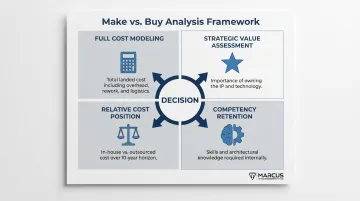
Outsourcing driven by capacity pressure — rather than structured make-vs-buy analysis — frequently leads to quality gaps and communication breakdowns. The decision should be grounded in:
- Full cost modeling (including management overhead, rework risk, and logistics)
- Strategic value assessment (importance of owning the technology/IP)
- Relative cost position (in-house vs. total cost of outsourcing over 10 years)
- Competency retention requirements
MIT Sloan research found that manufacturers who outsource too aggressively lose "architectural knowledge" and integration capability. A major European automaker had to re-hire engineers after ceding too much design authority to suppliers in the 1990s.
When Hybrid Models Work Better
Some situations call for a hybrid approach:
- Keep critical sub-assemblies in-house; outsource standard or commodity assemblies
- Partner on a build-to-print model with defined inline inspection checkpoints, rather than a fully delegated model
- Retain pre-development and simulation capabilities internally while outsourcing volume production
Toyota kept hybrid powertrain development in-house while competitors outsourced it. When EV demand accelerated, that retained expertise proved decisive — a useful reminder that strategic capability gaps are far harder to rebuild than they are to protect.
Conclusion
Done right, outsourcing product assembly delivers real reductions in cost and lead time—without trading away quality or control. The difference comes down to partner selection, quality frameworks, and clear scoping from the start.
The cheapest option rarely delivers the lowest total cost. Companies looking for a long-term assembly outsourcing partner should prioritize:
- Certified quality systems (IATF 16949, ISO 9001)
- End-to-end manufacturing capability under one roof
- Transparent processes with structured APQP, PPAP, and FAIR workflows
- Proven scalability in high-volatility industries
For teams in automotive, EV, aerospace, or industrial manufacturing, Marcus meets each of those criteria. With 45+ years of manufacturing experience, IATF 16949 and ISO 9001 certification, and assembly capability spanning die casting, CNC machining, surface treatment, and electro-mechanical assembly, Marcus operates from facilities across India, Vietnam, and China—positioned to serve global OEMs with consistent quality and reliable lead times.
Frequently Asked Questions
What is outsourcing in manufacturing?
Manufacturing outsourcing means contracting a third-party company to produce goods or components based on the buyer's design and specifications, rather than building in-house. It encompasses both component manufacturing and assembly, allowing OEMs to focus resources on design, R&D, and customer experience.
What is the assembly process in manufacturing?
Assembly in manufacturing is the process of joining individual parts, sub-components, or modules into a finished or semi-finished product. It can include mechanical fastening, welding, wiring, or electro-mechanical integration depending on the product type.
What is OEM vs contract manufacturing?
An OEM (Original Equipment Manufacturer) owns the product design and brand, while a contract manufacturer produces that product on the OEM's behalf. The OEM retains IP ownership and brand identity throughout the relationship.
What are the four types of outsourcing?
The four types are professional outsourcing (legal, accounting, consulting), IT outsourcing (software, infrastructure, cybersecurity), manufacturing outsourcing (production, assembly, fabrication), and process outsourcing (HR, payroll, customer service). Product assembly falls under manufacturing outsourcing, ranging from sub-assembly work to full turnkey production.
What are the 5 steps in the subassembly process?
The typical subassembly steps are:
- Component procurement
- Parts preparation and staging
- Assembly and joining operations
- Inline inspection
- Delivery to the main assembly line or OEM
What is an example of outsourcing manufacturing?
A common example is an automotive OEM outsourcing instrument panel sub-assembly to a certified contract manufacturer who handles fabrication, assembly, testing, and delivery as a complete package — freeing the OEM to focus on vehicle integration and launch timelines.