
Introduction
In automotive manufacturing, a single dimension out of tolerance can trigger cascading failures—safety recalls affecting thousands of vehicles, warranty claims running into millions, or assembly lines grinding to a halt at $22,000 per minute. To put this in perspective, Ford paid $5.83 billion in warranty claims in 2024 alone, while globally, automakers paid roughly $51 billion in warranty expenses in 2023. Many of these failures trace back to dimensional non-conformance in machined components—brake calipers with uneven clamping force, cylinder bores that leak oil, or gearbox housings that won't seal.
CNC machining eliminates this risk at scale. By converting CAD designs directly into physical parts with tolerances as tight as ±0.01 mm—and holding that precision across tens of thousands of units—it has become the production backbone of modern automotive manufacturing.
This guide covers the critical parts CNC machining produces, the materials and quality standards that govern the process, and how the technology is evolving to serve electric vehicles and next-generation programs.
TLDR:
- CNC machining delivers ±0.01 mm tolerances on safety-critical automotive components, preventing costly warranty failures
- Multi-axis machining centers run lights-out with minimal human intervention, compressing lead times on complex components
- Electric vehicle production is reshaping CNC demand—17 million EVs sold in 2024 require new precision parts like motor housings and battery enclosures
- IATF 16949-certified suppliers using APQP and PPAP give OEMs documented proof of process control before production begins
What Is CNC Machining in Automotive Manufacturing?
CNC (Computer Numerical Control) machining is a subtractive manufacturing process where pre-programmed computer code directs cutting tools to remove material from a workpiece. It converts a CAD design directly into a physical part with high precision and repeatability, without manual intervention between operations.
In automotive manufacturing, that consistency is non-negotiable. Cylinder heads, transmission gears, and brake calipers must be produced to identical specifications across thousands of units, because every assembled vehicle must perform to the same safety and efficiency standards.
Key CNC Processes in Automotive Manufacturing
The automotive industry relies on three primary CNC operations:
Milling shapes complex 3D geometries by moving a rotating cutter across the workpiece in multiple directions. Used for engine blocks, transmission housings, and structural brackets.
Turning/Lathe operations produce cylindrical parts like shafts, pistons, and bearing journals by rotating the workpiece against a stationary cutting tool. Essential for drivetrain components requiring precise diameter control.
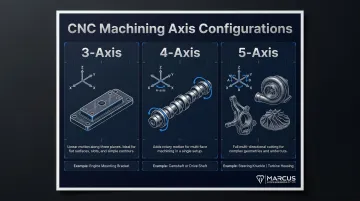
Multi-axis machining enables cuts from multiple angles in a single setup:
- 3-axis (X, Y, Z linear movement) handles flat surfaces and simple prismatic parts (box-like components with flat, angular faces)
- 4-axis adds one rotary axis for parts requiring features on multiple faces
- 5-axis machining is critical for complex engine and structural components, allowing simultaneous cutting from five directions, which eliminates multiple setups and improving dimensional accuracy on parts like steering knuckles and turbine housings
Prototype vs. Production Roles
CNC machining serves two distinct stages in automotive manufacturing:
| Stage | Goal | CNC Advantage |
|---|---|---|
| Rapid Prototyping | Turn around design changes in days | Engineers modify programs without new tooling investment, enabling geometry refinements between prototype rounds |
| Series/Mass Production | Meet identical dimensional specs across thousands of units | Automated cells with robotic loading and multi-tool changers run continuously, batch after batch |
Key Advantages of CNC Machining for Automotive Applications
Precision and Repeatability
Automotive parts such as engine cylinder heads and brake calipers demand tolerances in the range of ±0.002 mm to ±0.005 mm. Cylinder bores typically require ±0.002 mm to ±0.005 mm diameter tolerance with 0.003 mm roundness tolerance, while crankshaft main bearing journals hold ±0.005 mm. CNC machining achieves this consistently across large production runs, ensuring every assembled vehicle performs to specification.
Under IATF 16949, automotive production processes must demonstrate a preferred minimum process capability (Cpk) of ≥1.67, with 1.33 as an acceptable threshold. CNC machining's repeatable accuracy enables suppliers to meet these stringent requirements, reducing warranty exposure and assembly line disruptions.
Production Speed and Automation
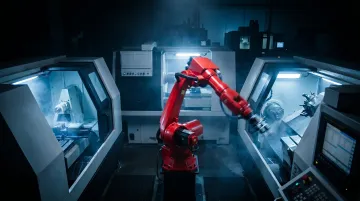
Automated tool changers, multi-axis simultaneous cutting, and robotic loading/unloading systems allow CNC machining centers to run continuously with minimal human intervention. BMW utilizes lights-out CNC processes for engine component machining, while FANUC has operated a lights-out factory since 2001, producing approximately 50 robots per day with the ability to run unsupervised for up to 30 days.
This directly reduces cycle times and lead times for suppliers managing tight OEM delivery schedules. That demand is reflected in the numbers: the global precision machining market is projected to grow from $134.25 billion in 2026 to $224.13 billion by 2034 at a 6.6% CAGR, driven largely by automotive volume.
Design Flexibility and Rapid Iteration
Changing a CNC program requires no new tooling investment, unlike casting or forging dies. Engineers can refine part geometries between prototype rounds or adapt to mid-lifecycle design changes without production delays—a practical advantage in programs where design timelines are compressed and customization demands are rising.
Material Versatility
A single CNC machining setup can be adapted to cut:
- Aluminum alloys (lightweight structural parts)
- Alloy steels (high-strength drivetrain components)
- Titanium (high-performance or EV applications)
- Engineering plastics and carbon fiber composites
One process covering this material range means fewer suppliers to qualify and less re-qualification overhead when shifting between vehicle programs.
Scalability from Prototype to Production
The same CNC process used to produce a single prototype can scale directly to medium and high-volume production without process re-qualification. First-article inspection results apply directly to series production, shortening the validation cycle and accelerating time-to-market for new vehicle programs.
Common CNC Machined Automotive Parts
Engine and Powertrain Components
Primary engine parts produced by CNC machining include:
- Cylinder heads
- Engine blocks
- Crankshafts
- Camshafts
- Pistons
- Valve bodies
These components operate under extreme heat, pressure, and friction, where even micron-level deviations affect combustion efficiency, oil sealing, and engine longevity. Crankshaft main bearing journals require ±0.005 mm tolerance, while crankpin journals hold ±0.008 mm.
Powertrain housings—including alternator housings and fuel pump bodies—are frequently produced by combining die casting for near-net-shape forming with CNC machining for critical mating surfaces, threads, and bore tolerances. This process combination balances high-volume efficiency with dimensional accuracy, reducing per-part cost while maintaining precision on safety-critical features.
Transmission and Drivetrain Parts
CNC machining produces:
- Transmission gears and gear shafts
- Gearbox housings
- Drive axles
- Differential components
These parts require tight tooth-profile tolerances and coaxiality control to ensure smooth power transfer. Multi-axis CNC machining centers complete these complex contours in fewer setups than traditional methods, reducing datum shift errors and improving concentricity.
CNC machining is also used for finishing operations on die-cast transmission housings—machining sealing faces, bearing bores, and mounting holes to the final precision fit required for assembly. Marcus Hi-Tech Engineering, for example, produces aluminium A380 HPDC gearbox housings that achieve ±0.01mm post-machining tolerance on bearing-bore-ready surfaces, enabling direct bearing press-fit on assembly lines.
Suspension, Steering, and Braking Systems
Suspension components include:
- Control arms
- Steering knuckles
- Wheel hubs
- Tie rods
These parts require simultaneous strength, dimensional accuracy, and lightweight design. CNC's ability to optimize tool paths enables material removal for weight reduction without compromising structural integrity. Steering knuckles produced on 5-axis CNC machining centers achieve tolerances as tight as ±0.005 mm.
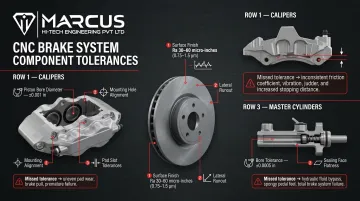
Brake system parts demand both dimensional control and surface finish:
- Calipers: Piston bore diameter, mounting hole alignment, and pad slot dimensions must be held to tight tolerances for even clamping force and balanced braking performance
- Rotors: Surface finish of Ra 30-60 micro-inches (0.75-1.5 micrometres) after machining ensures consistent friction performance
- Master cylinders: Bore tolerances and sealing face flatness are critical for hydraulic pressure integrity
Body, Interior, and Custom Components
Body and interior parts—dashboard frames, door panel inserts, lamp housings, and exterior trim—are CNC machined to deliver both structural precision and aesthetic surface quality. Multi-axis CNC operations achieve complex curves, fine chamfers, and high-gloss finishes that injection-molded or stamped processes cannot match at low-to-medium volumes.
Custom and aftermarket work extends these same capabilities into specialized, low-volume applications:
- Producing one-off or small-run performance parts (intake manifolds, exhaust brackets, suspension uprights for motorsport)
- Recreating obsolete components for vintage or rare vehicle restoration using reverse-engineered CAD data
Materials Used in Automotive CNC Machining
Primary Metal Materials
| Material | Density (g/cm³) | Tensile Strength (MPa) | Typical Applications |
|---|---|---|---|
| Aluminum 6061-T6 | 2.70 | 310 | Lightweight structural parts, brackets, housings |
| Aluminum 7075-T6 | 2.81 | 572 | High-strength aerospace-grade chassis components |
| AISI 4140 Steel | 7.85 | 1,020 | Drivetrain components, gears, crankshafts |
Cast iron (ASTM A48 Class 30) is used for engine blocks and brake discs due to excellent wear resistance, vibration damping, and relatively high machinability. Its graphite microstructure provides chip-breaking characteristics and natural lubrication during cutting.
Titanium alloys (Ti-6Al-4V) are reserved for high-performance and EV applications where strength-to-weight ratio is critical. With a density of 4.43 g/cm³ and tensile strength of 950 MPa, titanium delivers exceptional performance. However, its machinability rating of approximately 17% — compared to aluminum's 50–70% — requires reduced cutting speeds and specialized tooling, significantly impacting cycle time and cost.
Non-Metallic Materials
Engineering plastics including ABS, POM (acetal), and nylon are increasingly used for lightweight interior brackets, functional housings, and under-hood components where metal adds unnecessary weight or cost.
Carbon fiber composites serve racing car structures and EV battery enclosures where ultra-light, high-strength performance is required. These materials demand specialized tooling to prevent delamination and fiber pullout during machining.
Material Selection in Practice
With such a broad range of metals and composites available, choosing the right material is rarely straightforward. Automotive engineers weigh five factors on every program:
- Meets load-bearing requirements and defined safety margins (strength)
- Reduces vehicle mass to support fuel economy or EV range targets (weight)
- Keeps tool wear and cycle times within production economics (machinability)
- Survives underbody and engine bay exposure without degradation (corrosion resistance)
- Balances raw material price against total machining time and scrap rate (cost)
A single vehicle program may use five or more different CNC-machined materials across its components, with each choice impacting production planning and tooling strategy.
Automotive Quality Standards in CNC Machining
IATF 16949:2016 – The Automotive Quality Standard
IATF 16949:2016 is the automotive industry's dedicated quality management system standard, extending ISO 9001:2015 with automotive-specific requirements. It cannot be implemented standalone and applies to organizations that design, produce, or service automotive-related products.
Key automotive-specific additions:
- Product safety traceability across the supply chain
- Defect prevention and variation reduction processes
- Customer-Specific Requirements (CSRs) from individual OEMs
- Integration of five AIAG Core Tools: APQP, PPAP, FMEA, MSA, SPC
- Manufacturing process design can never be excluded from scope
IATF 16949 certification is mandatory for most Tier 1 automotive suppliers working with major OEMs like General Motors, Ford, and Stellantis. Approximately 30% of the more than 100 existing motorcar manufacturers follow the standard's requirements, with most large Asian OEMs maintaining separate but comparable quality systems.
APQP and PPAP Process Flow
Before a new automotive component enters production, suppliers must complete the Production Part Approval Process (PPAP): a documented validation that the manufacturing process consistently delivers parts within specification.
PPAP documentation includes:
- Dimensional reports with full CMM inspection data
- Material certifications and test results
- Process flow diagrams (PFMEA-linked)
- First Article Inspection Reports (FAIR)
- Control plans and capability studies (Cpk data)
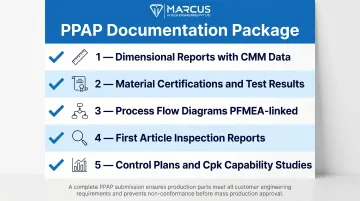
Together, this documentation confirms that every critical dimension, material property, and process parameter is validated before full production begins — reducing the risk of non-conformance, recalls, and warranty failures downstream.
With certification and pre-production validation in place, the focus shifts to maintaining quality throughout every production run.
In-Process Quality Control Methods
Automotive CNC suppliers use a layered inspection approach to catch deviations before they reach the assembly line:
- CMM (Coordinate Measuring Machines): Measure complex 3D geometries and verify GD&T callouts to ±0.001 mm accuracy
- Optical and laser scanning: Inspects contoured surfaces on parts like steering knuckles and intake manifolds where touch probes cannot reach
- Surface roughness measurement: Verifies Ra values on sealing faces, bearing bores, and visible trim components such as brake rotors and valve bodies
- Statistical Process Control (SPC): Monitors dimensional drift in real time, triggering alerts when a process approaches control limits
Marcus Hi-Tech Engineering holds IATF 16949:2016 and ISO 9001 certification and applies APQP, PPAP, and FAIR processes across its CNC machining operations. Its integrated shop — spanning 3/4/5-axis machining, VMC, Turn Mill, and VTL — operates alongside in-house die casting, with inline CMM metrology and SPC at every stage.
This end-to-end setup supports OEMs and Tier-1 suppliers who need near-net-shape production and precision finishing managed under one quality system.
CNC Machining in the Age of Electric Vehicles
The EV Production Surge
The shift from internal combustion engines (ICE) to electric powertrains is reshaping CNC machining demand at scale. Electric car sales topped 17 million worldwide in 2024 — up more than 25% year-on-year — representing over 20% of total global car sales. Sales in 2025 are projected to exceed 20 million units, with the IEA forecasting EV sales share above 40% by 2030.
That growth translates directly into new precision machining requirements.
While EVs eliminate some ICE-specific components—camshafts, cylinder heads, exhaust manifolds—they introduce new precision-critical parts with comparable or tighter tolerance requirements:
- Electric motor housings
- Rotor shafts
- Battery pack enclosures
- Inverter housings
- Thermal management components
Specific CNC Requirements for EV Components
Aluminum motor and inverter housings require thin-wall machining and precise bearing bore alignment. Even minor dimensional flaws affect motor balance, vibration, and thermal performance — making tolerance control non-negotiable.
Battery tray structures present a different challenge: accurate mounting interfaces and structural integrity must hold under crash loads. Dimensional errors here carry direct safety consequences, not just performance ones.
High-voltage connector housings require tight dimensional control for both electrical safety and sealing. Misaligned contacts or leakage paths can trigger arc hazards or cascading system failures.
Emerging Technology Trends
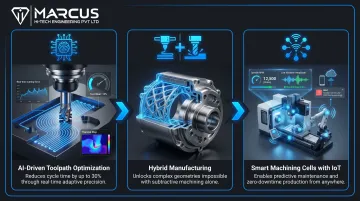
Three technology shifts are changing how EV components get machined:
- AI-driven toolpath optimization analyzes cutting forces, vibration, and tool wear in real time, adapting feeds and speeds dynamically to reduce cycle time and extend tool life
- Hybrid manufacturing combines additive and subtractive processes — manufacturers 3D-print parts with internal geometries impossible to machine, then CNC-finish critical surfaces to final dimensional tolerances
- Smart machining cells with IoT sensors track spindle temperature, vibration signatures, and cutting forces, flagging tool wear and machine issues ahead of costly downtime and pushing real-time alerts to off-site supervisors
Frequently Asked Questions
What is CNC machining in automotive?
CNC machining uses computer-controlled cutting machines to produce precision vehicle components from metal, plastic, or composite materials. It covers both prototype and production applications across engine, drivetrain, suspension, and body systems, converting CAD designs directly into physical parts with tolerances as tight as ±0.01 mm.
What are common CNC automotive parts?
The most widely CNC-machined automotive parts include cylinder heads, engine blocks, crankshafts, transmission gears and housings, brake calipers, suspension control arms, steering knuckles, dashboard frames, and EV motor housings. All require precision tolerances for safety-critical and performance-driven assemblies.
How accurate is CNC machining for cars?
Automotive CNC machining consistently achieves dimensional tolerances of ±0.01 mm on critical components, with CMM inspection capable of verifying dimensions to ±0.001 mm. This level of precision meets the stringent requirements for safety-critical assemblies like brakes, steering, and powertrain systems.
Is CNC machining expensive for autos?
Setup and programming costs are real, but they spread across production runs—making CNC cost-effective at medium-to-high volumes. Pairing die casting with CNC finish machining cuts per-part costs further by reducing material removal while holding precision on critical features.
Why use CNC lathe in automobile industry?
CNC lathes (turning centers) are ideal for producing cylindrical automotive parts—crankshafts, drive shafts, pistons, bearing journals, and gear shafts. They deliver precise diameter control, concentricity, and surface finish that manual turning cannot consistently achieve across high-volume rotating assemblies.
Is CNC better than forged?
They serve different purposes. Forging builds superior grain structure and fatigue strength for high-stress parts like connecting rods; CNC machining delivers tight tolerances and complex geometries. Most automotive parts are forged or cast first, then finish-machined to final dimensions—using both methods for their respective strengths.