Introduction
Electromechanical assembly sits where electrical circuits and mechanical structure meet — and for engineers and procurement teams sourcing complex subsystems, that intersection is one of the harder manufacturing challenges to get right. A sensor module for an EV, a cockpit panel for aerospace, a motor control unit for industrial automation: each of these demands both power delivery and physical motion within a single, compact unit.
This guide covers what electromechanical assembly is, the core components involved, the major types, the step-by-step manufacturing process, and how to evaluate a manufacturing partner.
TLDR
- Electromechanical assembly integrates electrical and mechanical components into functional systems that convert electrical signals into mechanical action
- Major types include cable and harness assemblies, sensor assemblies, panel assemblies, power supply assemblies, and box builds
- Process stages cover design review, component sourcing, sub-assembly, integration, testing, and quality inspection — governed by frameworks like APQP and PPAP
- Applications cover automotive/EV, aerospace, industrial, healthcare, energy, and electronics sectors
- Selecting the right partner comes down to certifications, DFM capability, full-assembly integration, and traceability in QA processes
What Is Electromechanical Assembly?
Electromechanical assembly is the process of combining electrical components—wiring, circuit boards, connectors, sensors—with mechanical components—housings, brackets, actuators, fasteners—to create a functional system that uses electrical input to drive mechanical output (or vice versa).
It sits at the intersection of two distinct disciplines:
- Electrical assembly routes or conditions power and signals but doesn't integrate moving parts or structural mechanics
- Mechanical assembly involves physical structure or motion without embedded electronics
- Electromechanical assembly requires both domains working in concert — producing systems like motor control units, sensor housings, or power distribution panels that convert electrical signals into physical action
The output of this process ranges from small subassemblies (a sensor module) to complete box builds integrating dozens of subassemblies, wire harnesses, PCBs, and power supplies into a finished, testable unit.
Because components are small, interdependent, and must meet tight tolerance requirements, manufacturers work from detailed blueprints, BOMs, and industry-standard processes like DFM and APQP to ensure consistency. A single misaligned connector or under-spec fastener can compromise the entire system.
The scale of this industry reflects that complexity. The global Electronics Manufacturing Services (EMS) market was valued at $612.67 billion in 2024 and is projected to reach $853.05 billion by 2030, growing at a CAGR of 5.6% — driven by demand across consumer electronics, IT & telecom, automotive, healthcare, and aerospace sectors.
Key Components of an Electromechanical Assembly
Every assembly is application-specific, but most share a common set of functional building blocks across three categories: electrical and electronic components, mechanical components, and interconnection elements.
Electrical and Electronic Components
These elements deliver power, control signals, and circuit logic:
- Wires and cables – route power and signal between components
- Connectors and terminals – enable modular connection and disconnection at interface points
- Circuit boards/PCBs – provide the platform for control logic and signal processing
- Switches and relays – control circuit operation; relays act as electrically operated switches for higher-power circuits
- Fuses and circuit breakers – protect against overcurrent and short circuits
Mechanical Components
Mechanical elements define the physical form, durability, and integration of the finished assembly:
- Housings and enclosures – protect internal components and mount the assembly into the parent system
- Brackets and mounting hardware – provide structural support and integration points
- Actuators and motors – convert electrical signals into linear or rotary mechanical motion
- Fasteners – secure components and ensure structural integrity
Interconnection and Wiring Elements
Wire harnesses and cable assemblies manage signal and power routing across the assembly:
- Wire harnesses – bundle multiple wires into a managed structure to reduce clutter, prevent wear, and simplify installation
- Cable assemblies – custom-configured for length, connector type, and shielding requirements
A poorly routed harness can cause chafing, intermittent faults, or installation delays — making routing discipline as important as component selection itself.
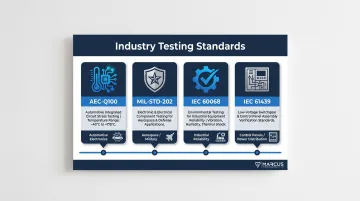
The operating environment shapes every component choice. Temperature ranges, vibration loads, moisture exposure, and EMI levels all determine which materials and ratings are acceptable. Industry standards define these thresholds:
| Standard | Scope | Application |
|---|---|---|
| AEC-Q100 | Automotive IC qualification (-40°C to 150°C, 10+ year life) | Automotive-grade semiconductors |
| MIL-STD-202 | Environmental testing for electronic components | Aerospace/military-grade components |
| IEC 60068 | Reliability testing (temperature, humidity, vibration, shock) | Industrial/commercial-grade components |
| IEC 61439 | Low-voltage switchgear and controlgear assemblies | Industrial control panel assemblies |
Types of Electromechanical Assemblies
Electromechanical assemblies are classified by their function and configuration in the end product. Understanding the type helps engineers specify the right manufacturing approach.
Switch and Sensor Assemblies
Sensor assemblies detect external stimuli (motion, heat, pressure, light) and convert them into electrical signals. Typical components include:
- Sensing element
- Transmitter
- Connection head
- Protective housing
Speed sensors, temperature sensors, and proximity sensors are common in automotive and industrial environments.
Cable and Wire Harness Assemblies
Cable and harness assemblies are systems of wires, cables, connectors, relays, fuses, and insulators designed to transmit power and signals throughout a larger device. The harness routes and protects all electrical connections — functioning as the nervous system of the full assembly.
The global automotive wires and cables market was valued at $55 billion in 2024 and is projected to reach $78 billion by 2030 at a CAGR of 5.3%. To put that in context: an average passenger vehicle contains about 1,500 meters of wiring harness across more than 1,200 individual wire circuits.
Panel and DIN Rail Assemblies
Panel assemblies distribute and control electrical power across connected circuits — common in industrial control panels and aerospace cockpits. DIN rail assemblies are modular mounting platforms for circuit breakers, relays, and terminal blocks.
IEC 61439 governs these assemblies, covering low-voltage switchgear and controlgear across power switchboards, distribution panels, construction site assemblies, and busbar trunking systems.
Power Supply and Transformer Assemblies
Power supply assemblies receive incoming current and condition it (correct voltage, current type) for the loads it serves. Core components include:
- Transformer
- Rectifier
- Filter
- Regulator
- Housing
Transformer assemblies specifically handle voltage conversion between circuits in multi-voltage systems.
Box Builds
A box build is the highest-level electromechanical assembly: a fully integrated enclosure containing PCBs, sub-assemblies, power supplies, cable harnesses, and mechanical hardware, assembled and tested as a complete, shippable unit.
Box builds require a manufacturing partner with end-to-end capability across fabrication, sub-assembly, integration, and testing. Components commonly include fans, motors, buttons, switches, LED indicators, and electrical connectors.
The Electromechanical Assembly Process: Step by Step
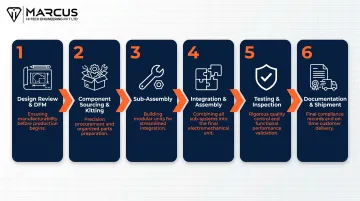
The assembly process follows a structured sequence — each stage builds on the last, and quality decisions made early (or skipped) directly affect the final product's reliability in the field.
Key stages:
Design Review and DFM – Review drawings, BOMs, and specs to identify manufacturability issues before production begins. According to a peer-reviewed study in the Journal of Materials Processing Technology, DFM can reduce assembly defects by up to 68% and assembly time by up to 61%.
Component Sourcing and Kitting – Procure all parts to spec and kit them for the assembly line.
Sub-Assembly – Build individual modules (harnesses, PCB assemblies, mechanical sub-frames) before integration.
Integration and Assembly – Combine sub-assemblies into the complete unit per blueprint.
Testing and Inspection – Perform functional testing, continuity checks, and dimensional verification using tools like CMM or automated test fixtures.
Documentation and Shipment – Generate quality records (PPAP, FAIR, test reports) and prepare the assembly for delivery.
Quality frameworks:
Three industry-standard frameworks govern how these stages are planned, validated, and documented — each targeting a different point in the production lifecycle:
| Framework | When It Applies | What It Verifies |
|---|---|---|
| APQP – Advanced Product Quality Planning | Concept through launch | Production readiness; minimizes lead times and startup defects |
| PPAP – Production Part Approval Process | Before volume production begins | Supplier process capability to produce consistent parts at scale |
| FAIR – First Article Inspection Report (AS9102) | First production run | All dimensions, materials, and processes meet customer and design requirements |
Industries and Applications
Electromechanical assemblies are foundational to any product that must both manage electrical energy and perform a physical action. Demand spans nearly every major manufacturing sector.
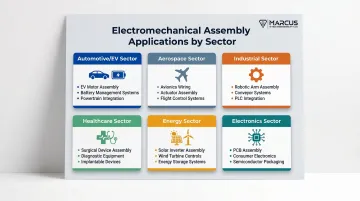
Applications by sector:
| Sector | Applications |
|---|---|
| Automotive/EV | Speed sensors, relay modules, battery management system assemblies, motor control units. An average EV integrates approximately 4.2 km of wiring weighing approximately 68 kg, nearly 2x the wiring content of ICE vehicles. |
| Aerospace | Cockpit panel assemblies, power boxes, junction boxes—with an emphasis on compact, high-reliability builds meeting RTCA DO-160 environmental standards. |
| Industrial | Control panels, DIN rail assemblies, actuator modules for automation equipment—typically compliant with IEC 61439 standards. |
| Healthcare | Diagnostic device assemblies, IV pump modules, imaging equipment sub-assemblies. IEC 60601 series contains close to 60 special requirement documents for specific device categories. |
| Energy | Power conversion units, monitoring and control assemblies for solar and wind installations. The global solar inverter market was valued at $11.99 billion in 2024 and is projected to reach $25.81 billion by 2034. |
| Electronics | Enclosure builds, circuit board assemblies for data center and consumer electronic equipment. |
Marcus serves global customers across these sectors—from automotive and EV to aerospace, energy, and industrial manufacturing—delivering electromechanical assemblies as part of a vertically integrated manufacturing program spanning die casting, machining, sheet metal, and plastics through to finished assembly.
How to Choose the Right Electromechanical Assembly Partner
Outsourcing electromechanical assembly involves more than finding a low-cost vendor. The partner must have the technical depth, quality infrastructure, and supply chain capability to support the full product lifecycle.
Key criteria to evaluate:
1. Certifications
ISO 9001 and IATF 16949:2016 are baseline indicators of process discipline and quality system maturity.
- ISO 9001:2015 covers any organization that must consistently deliver products meeting customer and regulatory requirements — the universal quality baseline.
- IATF 16949:2016 is site-specific and applies where value-added manufacturing (assembly, welding, heat treatment, painting) actually takes place — mandatory for automotive supply chains.
2. DFM and Engineering Support
A capable partner will flag manufacturability issues early and support design optimization before tooling is committed. Companies that implemented comprehensive DFM guidelines achieved:
- 60% reduction in defect rates (medical devices)
- 25% reduction in production costs (automotive parts)
- 40% decrease in time-to-market (automotive)

3. End-to-End Capability
Partners who can supply fabricated components (die cast, machined, sheet metal) alongside assembly services simplify the supply chain and reduce handoff risk.
97% of companies surveyed in late 2023 stated they were reconfiguring their supply chains, with 86.2% working to de-risk their supply chains through vertical integration.
4. Testing and Inspection Infrastructure
Inline inspection, functional testing fixtures, and advanced metrology (CMM) confirm that assemblies leave the facility conforming to spec.
5. Global Footprint and Scalability
The ability to source from a multi-country supply chain and scale output flexibly matters for customers managing variable demand.
Marcus as a manufacturing partner:
Marcus holds IATF 16949:2016 and ISO 9001 certifications and brings 45+ years of manufacturing experience to each engagement. Its processes span DFM, APQP, and PPAP, with complete end-to-end capability across die casting, CNC machining, and electromechanical assembly. Production runs from its Coimbatore facility with supply chain reach across India, Vietnam, and China — serving OEMs and Tier-1 suppliers globally.
Frequently Asked Questions
What is an example of an electromechanical assembly?
Common examples include an automotive speed sensor module, a cockpit panel assembly in aerospace, a motor control unit in an EV, and a power supply assembly in industrial machinery. Each integrates electrical and mechanical components to perform a specific function.
What are common electro-mechanical parts and subassemblies?
Common parts include wires, cable harnesses, connectors, switches, relays, PCBs, power supplies, housings, brackets, and actuators. Subassemblies include wire harness assemblies, sensor assemblies, and panel assemblies.
How does electro-mechanical assembly differ from electrical and mechanical assembly?
Electrical assembly deals only with power/signal routing without moving parts. Mechanical assembly involves only structural or moving parts without electronics. Electromechanical assembly combines both, creating systems where electrical inputs drive mechanical outputs or vice versa.
What are the different types of electronic and electro-mechanical assembly?
Main types include cable and wire harness assemblies, switch and sensor assemblies, panel and DIN rail assemblies, power supply and transformer assemblies, and box builds. Each type serves a different functional role in the end product.
What are the typical steps in the electro-mechanical subassembly process?
Key steps include design review and DFM, component sourcing/kitting, sub-assembly, integration, functional testing and inspection, and documentation/shipment. Quality frameworks like APQP and PPAP govern the process to ensure repeatability and conformance at each stage.
What are the duties and responsibilities of an electro-mechanical assembler?
Core responsibilities include reading blueprints and schematics, assembling electrical and mechanical components to specification, performing continuity and functional tests, troubleshooting defects, and documenting the assembly process for quality records.