What are aluminum battery housings used for in electric vehicles?
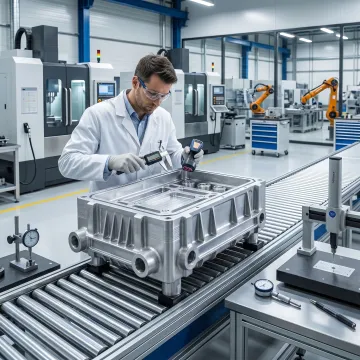
Aluminum battery housings are used to protect EV battery packs while supporting structural performance, thermal management, and integration with the vehicle platform. They typically include mounting features, sealing surfaces, and interfaces for covers, cooling systems, and electrical components. Because aluminum offers a strong strength-to-weight ratio, it is widely used to reduce mass without sacrificing durability.
Why is aluminum a good material for EV battery housings?
Aluminum is valued for EV battery housings because it combines low weight, corrosion resistance, and good manufacturability. It can be cast into complex structural shapes, machined to tight tolerances, and finished for added durability. These properties help OEMs balance crash performance, dimensional accuracy, and production efficiency while supporting broader vehicle lightweighting goals.
Which manufacturing processes are best for aluminum battery housings?
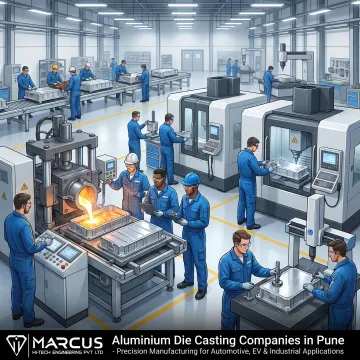
The best process depends on part size, geometry, wall thickness, and production volume. Low pressure die casting is often preferred for dense, structural parts with reduced porosity, while cold chamber die casting suits complex aluminum components at higher volumes. CNC machining is then used to finish critical sealing faces, threaded features, and precision interfaces required for final assembly.
Can Marcus support both prototype and production battery housing programs?
Yes. Marcus supports low-volume prototype work as well as high-volume OEM production through its integrated manufacturing setup. The company offers new product development support, in-house tooling control, trial runs, machining, finishing, and assembly. This helps customers move from early validation to scaled production with better continuity, fewer supplier transitions, and stronger process consistency.
What quality standards does Marcus follow for EV battery housing manufacturing?
Marcus operates under IATF 16949:2016 and ISO 9001 certified quality systems. Depending on the program, production and launch controls can include DFM review, APQP, PPAP, FAIR, inline inspection, and advanced metrology. These frameworks are important for EV and automotive components because they support traceability, repeatability, and documented validation throughout development and production.
What machining features can be finished on aluminum battery housings?
Marcus can machine critical features such as sealing surfaces, bearing or locating bores, threaded interfaces, mounting points, and datum-controlled mating faces. Toolpaths are programmed from customer 3D CAD models, and custom jigs are used to maintain positional accuracy across production runs. This is essential for battery housings that must fit precisely with covers, modules, and vehicle structures.
Are surface treatments available for aluminum battery housing components?
Yes. Marcus offers in-house surface finishing and treatment options including anodising, powder coating, conversion coating, blasting, and heat treatment. These processes can improve corrosion resistance, wear performance, and surface durability depending on the application. Batch-level testing and certification support are also available, helping customers meet functional and quality requirements without outsourcing finishing operations.
Which markets and regions can Marcus supply for EV battery housing projects?
Marcus serves global customers across regions including India, North America, the United Kingdom, Australia, Mexico, Vietnam, Italy, and the Middle East Asia. With headquarters in Coimbatore and a broader partner network across India, Vietnam, and China, the company is positioned to support international sourcing strategies, scalable production planning, and consolidated supply for multi-region manufacturing programs.