What types of oil and gas components can Marcus machine?
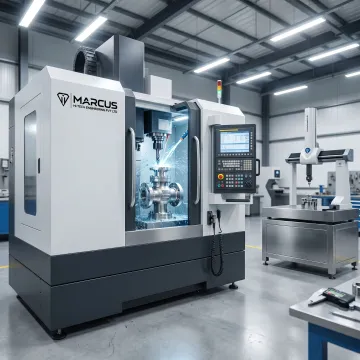
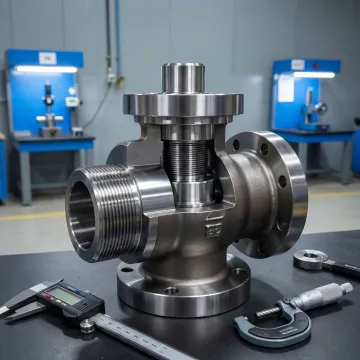
Marcus can machine a wide range of precision components used in oil and gas and related industrial applications, including housings, covers, brackets, manifolds, sealing faces, threaded interfaces, bearing bores, and other critical mating features. With 3/4/5 axis machining, turn-mill capability, and custom fixturing, the team supports both prototype and production requirements for complex geometries.
What machining tolerances can you achieve?
Marcus performs precision machining to tolerances as tight as ±0.005 mm on critical features such as mating faces, bearing bores, threaded interfaces, and sealing surfaces. Actual achievable tolerance depends on part geometry, material, and feature type, but the process is supported by custom jigs, defined datums, and advanced inspection methods to maintain repeatability across production runs.
What materials do you machine for oil and gas applications?
Marcus machines aluminium, zinc, and magnesium components in-house and also supports broader manufacturing programs through its partner network for forged, cast, extruded, and fabricated parts. Material selection can be aligned with strength, corrosion resistance, weight, and downstream finishing requirements, helping customers source components that match both performance and production needs.
Do you offer finishing or coating after machining?
Yes. Marcus provides in-house surface finishing and treatment options including anodising, powder coating, plating, blasting, polishing, chromation, resin impregnation, and heat treatment. This single-source approach helps reduce outsourcing delays and improves process control. Finished parts are tested to standards such as ASTM B117, XRF coating thickness, and adhesion cross-hatch, with batch certificates supplied on shipment.
Can you support prototypes as well as production volumes?
Yes. Marcus supports early-stage development, prototyping, validation, and scaled production. The company’s New Product Development framework includes DFM collaboration, simulation, rapid prototyping, T0 and T1 trials, and inspection planning before scale-up. This makes it suitable for customers who need a supplier that can move from initial samples to repeatable production without changing partners.
What quality systems do you follow?
Marcus operates under IATF 16949:2016 and ISO 9001 certified quality systems. Programs are supported by structured manufacturing and validation practices including DFM, APQP, PPAP, FAIR, inline inspection, and advanced metrology such as CMM inspection. These systems help maintain process discipline, documentation, and consistency for customers with demanding technical and quality requirements.
Do you provide tooling and fixture support for machined parts?
Yes. Marcus has a dedicated in-house Tool Room that manages tool design, jigs, fixtures, CAD/CAM integration, simulation, trials, maintenance, repair, and engineering changes. This capability improves setup accuracy and repeatability by locating parts from defined datums and controlling feature positions throughout the production run, which is especially valuable for precision machined components.
Can Marcus serve customers outside India?
Yes. Marcus serves customers across India, Australia, the United Kingdom, North America, the Middle East Asia region, Italy, Mexico, and Vietnam. In addition to its Coimbatore base, the company works through a broader manufacturing network across India, Vietnam, and China, helping global buyers consolidate sourcing while maintaining certified quality and coordinated supply support.