What medical device assembly services does Marcus provide?
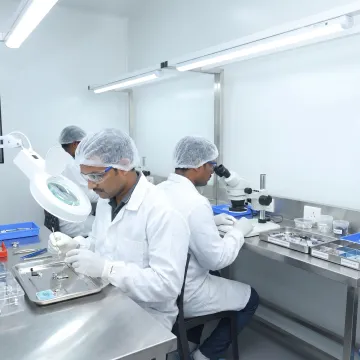
Marcus provides mechanical, electro-mechanical, and semi-automated assembly services for precision components and finished sub-assemblies. Capabilities include cable crimping, connector integration, sensor housing assembly, ultrasonic welding, crimping, plastic over-moulding integration, inline inspection, and functional testing. This supports both prototype builds and higher-volume OEM production while helping customers consolidate multiple manufacturing steps with one supplier.
What coating and finishing options are available for medical components?
Available finishing options include electroplating, electroless plating, anodising, powder coating, wet painting, PVD coating, blasting, polishing, chromation, conversion coating, and heat treatment. Parts undergo pre-treatment such as degreasing, acid cleaning, and activation before finishing. This allows Marcus to support functional, corrosion-resistant, and appearance-critical requirements for medical and precision-engineered components.
Does Marcus support both prototypes and production volumes?
Yes. Marcus supports low-volume prototypes as well as high-volume OEM production through dedicated semi-automated assembly lines and structured manufacturing processes. Customers can move from early development into scaled production with the same partner, which helps maintain process continuity, reduce qualification risk, and simplify supplier management across the product lifecycle.
What quality certifications does Marcus hold?
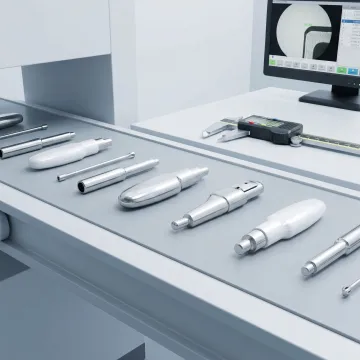
Marcus operates under IATF 16949:2016 and ISO 9001 certified processes. In addition to these certifications, the company applies structured quality methods such as DFM, APQP, PPAP, and FAIR where required. Inline inspection, advanced metrology, and documented testing help support repeatability, traceability, and controlled production for precision assemblies and coated components.
How does Marcus verify coating quality and consistency?
Marcus verifies coating performance through process controls and post-finish testing. Depending on the finish, testing may include ASTM B117 salt spray evaluation, XRF coating thickness checks, adhesion cross-hatch testing, and batch-level certification. These controls help confirm coating coverage, durability, and consistency across production runs, especially for precision parts with demanding functional requirements.
Can Marcus handle electro-mechanical medical assemblies with testing?
Yes. Marcus assembles electro-mechanical modules that combine mechanical parts with electronic systems and performs in-line electrical testing to validate performance. Typical work includes cable crimping, connector integration, switches, and sensor housing assemblies. This capability is useful for medical products that require both precise mechanical fit and verified electrical functionality before shipment.
What materials and component types can be finished or assembled?
Marcus supports a broad range of metallic and hybrid components, including aluminium, zinc, magnesium, machined parts, die castings, stamped parts, forged parts, and moulded plastic elements integrated into assemblies. Finishing options are matched to the substrate and performance requirement, allowing customers to source assembled and coated components for precision medical and healthcare-related applications.
How can medical manufacturers reduce lead times with Marcus?
Lead times can be reduced by using Marcus as a single manufacturing partner for tooling support, machining, assembly, finishing, inspection, packaging, and fulfilment. Keeping these operations coordinated within one quality framework reduces external handoffs, shortens scheduling gaps, and improves communication. That structure helps customers accelerate time-to-market while maintaining documentation and production control.