What types of sheet metal fabrication does Marcus provide?
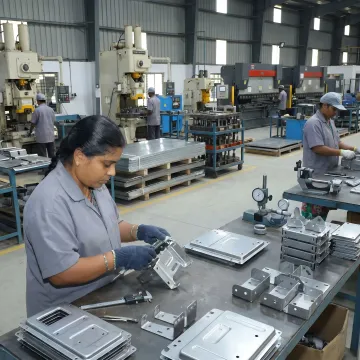
Marcus supports industrial sheet metal fabrication through its certified partner network, including progressive die stamping, transfer die stamping, and deep draw stamping. These capabilities are suited to automotive, appliance, and industrial applications. Secondary operations such as painting, welding, anodising, plating, and heat treatment can also be coordinated, allowing customers to source more complete, production-ready components through one manufacturing partner.
Can Marcus handle finishing for fabricated sheet metal parts?
Yes. Marcus offers extensive finishing support for fabricated components through its in-house surface treatment capability and coordinated manufacturing processes. Available options include powder coating, wet painting, chrome and nickel electroplating, anodising, PVD coating, blasting, polishing, and heat treatment. Parts are prepared with appropriate cleaning and pre-treatment steps, then tested to recognized standards such as ASTM B117 and coating thickness checks.
Does Marcus provide assembly services for fabricated metal components?
Yes. Marcus can integrate fabricated sheet metal parts into mechanical and electro-mechanical assemblies. Services include sub-assembly work, crimping, ultrasonic welding, connector integration, cable work, and inline inspection or functional testing where required. This is especially useful for customers who want to reduce supplier handoffs and receive finished modules or ready-to-install assemblies instead of managing multiple vendors.
What industries does Marcus serve with industrial fabrication?
Marcus supports customers in automotive, EV, aerospace, electronics, healthcare, energy, and broader industrial manufacturing sectors. Its fabrication and related manufacturing capabilities are designed for programs that require repeatable quality, engineering oversight, and scalable production. Because Marcus also supports machining, finishing, and assembly, it is well suited to customers with complex components or multi-process manufacturing requirements.
What quality certifications does Marcus hold?
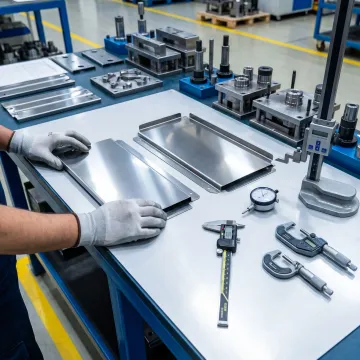
Marcus operates under IATF 16949:2016 and ISO 9001 certified quality systems. In addition to these certifications, the company applies structured manufacturing and quality processes such as DFM review, APQP, PPAP, FAIR inspection, inline inspection, and advanced metrology support. These systems help maintain consistency, traceability, and production control across fabrication programs and related secondary operations.
Can Marcus support new product development for sheet metal parts?
Yes. Marcus supports new product development with DFM collaboration, simulation-led review, rapid prototyping, tooling support, T0 and T1 trials, and validation processes before scale-up. This helps customers identify manufacturability issues early, improve part performance, and reduce delays during launch. The dedicated tool room and broader manufacturing capabilities make Marcus a strong fit for development-to-production programs.
Does Marcus offer machining after sheet metal fabrication?
Yes. Marcus provides in-house CNC machining to support fabricated components that require tighter tolerances, secondary feature creation, or precision finishing on critical interfaces. The machining department includes 3, 4, and 5-axis equipment, turn-mill centres, and drill-tap centres. This allows fabricated parts to be refined and completed within a more controlled manufacturing workflow rather than being outsourced separately.
Can Marcus serve customers outside India?
Yes. Marcus serves customers across India as well as international markets including Australia, the United Kingdom, North America, Italy, Mexico, Vietnam, and the Middle East Asia region. Its manufacturing model combines a Coimbatore base with a broader partner network across India, Vietnam, and China, helping customers access scalable production and coordinated supply support for global programs.