What is a battery module in an EV?
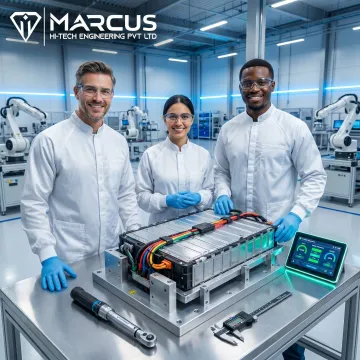
A battery module in an EV is a sub-assembly made up of multiple battery cells grouped together within a structural and electrical framework. It typically includes cell holders, busbars, connectors, sensing elements, insulation components, and protective housings. Modules are then integrated into a larger battery pack, making them a critical building block for performance, safety, and serviceability.
What does a battery module do?
A battery module organizes and connects individual cells so they can safely deliver the required voltage, current, and thermal stability within an EV battery system. It supports electrical continuity, structural protection, monitoring integration, and reliable fit within the final pack. Proper module assembly helps improve consistency, quality control, and downstream pack integration during vehicle production.
What services are included in EV battery module assembly?
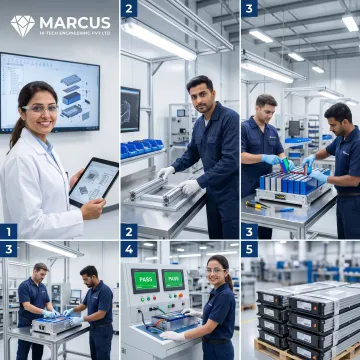
EV battery module assembly services can include mechanical assembly, electro-mechanical integration, cable crimping, connector installation, sensor housing assembly, fixture development, CNC-machined component support, in-line testing, packaging, and labeling. Marcus also supports prototype-to-production transitions through tooling, new product development, and certified quality processes, helping customers consolidate multiple manufacturing steps with one supplier.
Can Marcus support both prototype and production battery module programs?
Yes. Marcus operates semi-automated assembly lines designed for both low-volume prototype work and high-volume OEM production. This allows customers to validate designs, refine assembly methods, and scale output without changing manufacturing partners. Combined with in-house tooling, machining, and structured NPD support, this approach helps reduce launch risk and improve continuity from development through serial production.
What quality standards are used for battery module assembly?
Marcus manufactures under IATF 16949:2016 and ISO 9001 certified processes, supported by industry-standard methods such as DFM, APQP, PPAP, and FAIR where required. Inline inspection, functional testing, and advanced metrology help verify assembly quality throughout production. These systems are especially important for EV and automotive programs where repeatability, traceability, and process discipline are essential.
Does Marcus provide in-line testing during assembly?
Yes. In-line testing is part of Marcus's electro-mechanical assembly capability and is used to validate performance during production. Depending on the application, this may include electrical checks, connector verification, dimensional inspection, and functional validation of assembled modules or sub-assemblies. Testing within the assembly flow helps identify issues early and supports more consistent outgoing quality.
Can battery module assemblies include machined, plastic, and metal parts together?
Yes. Marcus supports hybrid assemblies that combine machined metal parts, die-cast components, stamped parts, injection-moulded plastics, and over-moulded elements within one finished assembly. This is valuable for EV battery modules that require structural parts, electrical interfaces, housings, and fastening features to work together precisely. A single-source approach can simplify coordination and reduce supply chain complexity.
What industries does Marcus serve with assembly services?
Marcus supports customers in EV, automotive, aerospace, electronics, energy, healthcare, and industrial manufacturing. Its assembly capabilities are suited to programs that require precision integration, certified quality systems, and scalable production support. Because the company also offers machining, tooling, finishing, and development support, it can serve manufacturers looking for a broader end-to-end production partner.