What is cold forging used for?
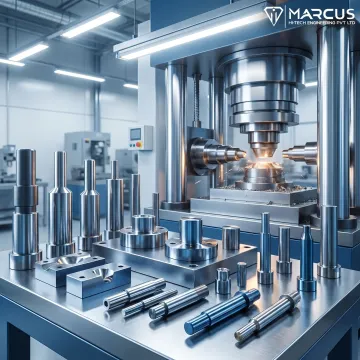
Cold forging is commonly used for precision metal components that require strong dimensional consistency, good surface finish, and efficient high-volume production. It is well suited to automotive, EV, industrial, electronics, and hardware applications where repeatability matters. Typical parts include fasteners, fittings, housings, shafts, and other components that benefit from near-net-shape forming and reduced secondary processing.
What materials can be used in cold forging?
Cold forging is typically used with metals that can be plastically deformed at or near room temperature while maintaining required mechanical properties. Material selection depends on part geometry, tolerance targets, and end-use performance. For production programmes, Marcus supports customers through material and process planning alongside broader manufacturing services to align forging routes with machining, finishing, and assembly requirements.
How accurate is the cold forging process?
Cold forging is valued for high dimensional accuracy and repeatability, especially in high-volume applications. It can reduce the amount of machining needed compared with less precise forming methods. Final accuracy depends on part design, tooling quality, material behaviour, and any secondary operations. Marcus strengthens process control through tooling support, in-house machining capability, and structured quality methods including FAIR, APQP, and PPAP.
Can forged parts be machined after forming?
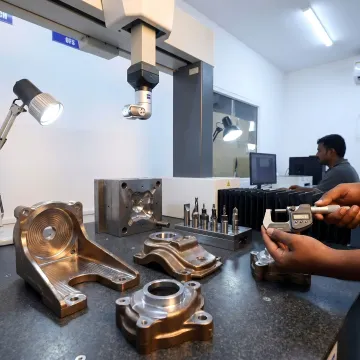
Yes. Many forged components are machined after forming to achieve critical tolerances, sealing faces, threaded features, or precision mating surfaces. Marcus offers in-house CNC machining with 3/4/5 axis capability and tolerances down to ±0.005mm on critical features. This allows forged parts to move efficiently from forming into precision finishing under one coordinated manufacturing workflow.
Do you provide tooling support for cold forging projects?
Yes. Marcus supports programmes with an in-house tool room that handles tool design, CAD/CAM integration, DFM review, simulation, trials, maintenance, and engineering changes. This is especially valuable for cold forging projects because tooling quality directly affects repeatability, part accuracy, and production stability. In-house oversight also helps speed up validation and reduce delays during launch or revision stages.
What quality standards do you follow?
Marcus operates under IATF 16949:2016 and ISO 9001 certified quality systems. Depending on the programme, quality planning and validation can include supplier audits, APQP, PPAP, and FAIR inspection. Additional support across machining, finishing, and assembly includes inline inspection and advanced metrology. This structured framework helps customers maintain traceability, consistency, and confidence across demanding production requirements.
Can you supply finished forged components instead of raw parts?
Yes. Marcus can support customers beyond raw forged parts by coordinating machining, surface finishing, treatments, and assembly as part of a single-source manufacturing model. This helps reduce supplier fragmentation and simplifies procurement. Customers can receive components that are closer to final use requirements, including precision-machined features, protective finishes, and sub-assembled configurations where needed.
Which industries do you serve with forging-related manufacturing?
Marcus supports a broad range of sectors including automotive, EV, aerospace, healthcare, electronics, energy, and industrial manufacturing. The company is structured to help OEMs and industrial buyers manage both development and production requirements through integrated manufacturing support. This makes it suitable for programmes that need certified quality systems, scalable supply, and coordination across multiple manufacturing processes.