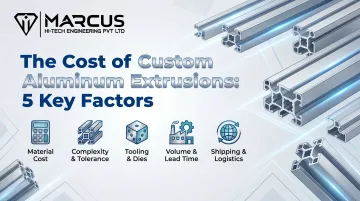
This article breaks down realistic pricing ranges and the 5 key cost drivers that determine what your custom aluminum extrusion project will actually cost.
TL;DR
- Custom extrusion pricing is never fixed—costs swing based on design complexity, alloy choice, production volume, finishing, and global sourcing decisions
- Die tooling is a one-time upfront charge, ranging from a few hundred to several thousand dollars depending on geometry
- Raw aluminum represents the largest per-unit cost and fluctuates with global commodity markets
- Higher volumes lower unit cost—tooling charges hit hardest on small runs, while bulk orders spread those fixed costs across more pieces
- Finishing, machining, and shipping costs add up fast — budget for them upfront, not as afterthoughts
How Much Do Custom Aluminum Extrusions Cost?
There is no single price for custom aluminum extrusions. Costs depend on alloy selection, profile complexity, order volume, finishing requirements, and manufacturing location.
Misreading these factors is expensive. Common missteps include:
- Focusing only on per-kg material price while ignoring die costs
- Overlooking tooling charges on low-volume runs
- Missing finishing, machining, and international logistics in the final budget
Typical Price Ranges
Per-kg pricing for custom aluminum extrusions varies widely based on alloy, complexity, and geography (all prices in USD):
- Standard 6063 profiles: \$2.50–\$3.80/kg in 2025 — China runs \$2.50–\$3.50/kg, India \$2.00–\$3.00/kg, Southeast Asia \$2.40–\$3.20/kg, and North America or Europe \$3.50–\$5.00+/kg
- Moderate complexity profiles: $3.50–$5.00/kg depending on tolerances and geometry
- Premium alloy 6061-T6: $4.00–$6.00/kg, representing a 10–20% premium over 6063 pricing
For per-pound benchmarks, finished extrusions range from $2.00–$4.50/lb depending on order size:
- 1,000 lb order: approximately $3.50/lb
- 10,000 lb order: approximately $2.75/lb
- 50,000 lb order: approximately $2.20/lb
Volume discounts are significant — worth factoring into sourcing decisions early. Tooling adds a separate, one-time charge on top of per-unit pricing:
Die costs by complexity:
- Simple solid dies: $300–$800
- Semi-hollow or single hollow dies: $800–$2,000
- Complex multi-void or large-section dies: $2,000–$5,000+
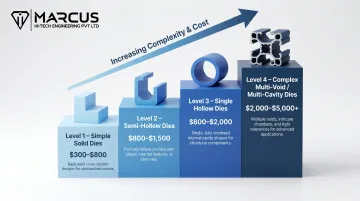
Standard die fabrication lead times typically run 3–5 weeks, depending on complexity.
What these ranges typically include:
- Base extrusion processing
- Standard alloy (6063 or similar)
- Mill finish (as-extruded surface)
What they exclude:
- Surface treatment (anodizing, powder coating)
- Secondary machining (drilling, cutting, CNC work)
- Logistics, freight, and import duties
- Expediting premiums for rush orders
5 Key Factors That Affect the Cost of Custom Aluminum Extrusions
Pricing for custom aluminum extrusions depends on a combination of technical, material, and operational factors. Understanding each one helps you build a more accurate budget and make smarter design decisions.
Factor 1: Die and Tooling Costs
Every custom profile requires a purpose-built extrusion die—a non-negotiable one-time investment. Die cost depends heavily on profile complexity, circumscribed circle diameter (CCD), and whether the profile is solid or hollow.
Realistic tooling cost ranges based on current supplier data:
- Simple solid dies: $300–$800
- Semi-hollow dies: $800–$1,500
- Single hollow dies: $800–$2,000
- Complex multi-void or large-section dies: $2,000–$5,000+
- Multi-cavity dies: $1,500–$5,000+
Standard lead times for die fabrication typically run 7–20 days for fabrication itself, plus 2–4 weeks total when including design approval and finishing steps.
Die cost amortizes sharply at scale. A $2,000 die spread over 50,000 kg adds approximately $0.04/kg; the same die over 5,000 kg adds $0.40/kg—a tenfold difference. Volume planning is therefore one of the most effective levers for controlling tooling expense.
Factor 2: Raw Aluminum Material Costs
Raw aluminum is the largest single cost component in any extrusion order, typically representing 60–75% of total per-unit cost. Prices are set by global commodity markets such as the London Metal Exchange (LME) and fluctuate based on energy costs, supply chain conditions, and geopolitical events.
Recent aluminum price ranges illustrate market volatility:
LME monthly settlement prices ranged from approximately $2,179/MT in February 2024 to $2,876/MT by December 2025, rising further to $3,373/MT by March 2026—a 55% increase over two years.
Alloy choice affects base material cost:
- 6063 alloy: Easier to extrude, better surface finish, lower cost baseline
- 6061 alloy: Higher strength, harder to extrude, slower production speeds, and carries a 10–20% premium over 6063
Price volatility can be partially managed. Some manufacturers allow buyers to pre-purchase aluminum stock at a fixed rate, reducing unpredictability for long-term projects. LME-based hedging instruments and futures contracts are used by manufacturers and large buyers to lock in pricing against adverse market moves.
Factor 3: Profile Complexity and Design
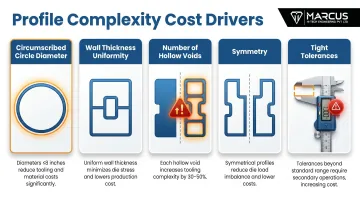
The geometry of your profile directly impacts both die cost and production efficiency. Key complexity drivers include:
- Circumscribed Circle Diameter (CCD): The smallest circle that encloses the cross-section. Most economical profiles have a CCD of 1–10 inches; profiles below 8 inches significantly reduce costs
- Wall thickness uniformity: Balanced, consistent walls extrude faster and reduce scrap
- Number of hollow voids: Hollow profiles can increase tooling costs by 30–50% versus solid profiles
- Symmetry: Symmetrical designs extrude more predictably and require less die adjustment
- Tight tolerances: Tighter specs slow production and drive up inspection costs
Design decisions that increase cost:
- Asymmetric profiles requiring special tooling
- Very large CCD pushing dies into the $2,000–$5,000+ range
- Thin walls with tight tolerances
- Unnecessary undercuts or deep recesses
Design choices that reduce cost:
- Symmetrical profiles with consistent wall thickness
- Avoiding multi-void hollow sections when solid or semi-hollow will work
- Keeping wall thickness above 1 mm
- Simplifying geometry to reduce die complexity
A DFM review before tooling is committed can catch profile simplifications that reduce die cost and scrap rates. Marcus Hi-Tech Engineering applies DFM, APQP, and PPAP processes across automotive, EV, and industrial components—evaluating designs early to avoid expensive geometry decisions downstream.
Factor 4: Surface Finishing and Secondary Operations
The base extrusion comes in "mill finish"—the as-extruded surface with no treatment. Any additional surface treatment or secondary operations add cost on top of the per-kg extrusion price.
Common finishing options and approximate cost ranges:
- Anodizing: Approximately $0.50–$1.50 per square foot or $0.10–$0.30/kg additive
- Powder coating: Approximately $1.00–$3.00 per square foot or $0.20–$0.50/kg additive
- Chemical film (Alodine): Lower cost than anodizing, used for corrosion resistance and paint prep
Secondary machining:
CNC machining for slots, holes, cuts, or bends can add approximately 15–40% over baseline extrusion cost, depending on complexity.
Working with a manufacturer who handles extrusion, machining, and finishing under one roof reduces coordination overhead and typically lowers total cost compared to managing multiple vendors separately. Marcus Hi-Tech Engineering offers in-house CNC machining (3/4/5-axis) alongside coordinated finishing through vetted partner networks, consolidating these workflows into a single managed program.
Factor 5: Production Volume
Fixed costs like die fabrication, setup, and production scheduling spread over more units as volume increases, making per-unit cost substantially lower at high volumes versus prototype or low-volume runs.
Volume effect on per-unit pricing:
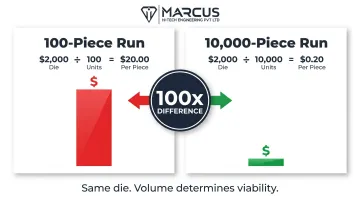
Consider the same $2,000 die:
- 100-piece run: Die cost = $20.00 per piece
- 10,000-piece run: Die cost = $0.20 per piece
That 100x difference means getting volume projections right at the quoting stage directly affects whether the program is cost-viable.
Minimum order quantity (MOQ) considerations:
Typical MOQ for new custom profiles is around 500–1,000 kg; higher for complex or tight-tolerance parts (800–1,200 kg). Prototype or sample runs of 100–300 kg are available at a premium. Finishing lines often impose their own MOQs—800–1,200 kg for powder coating and 1,000 kg for anodizing—which can govern the final order size.
Bulk buyers can often negotiate better per-kg rates and die cost rebates, while orders below MOQ thresholds may incur setup premiums.
Full Cost Breakdown: Beyond the Per-Kilogram Price
The per-kg extrusion price is only part of the picture. Total project cost includes one-time, recurring, and logistics-related components that must all be factored into the budget.
Key cost components (USD):
- Tooling/die — One-time charge: $300–$5,000+ depending on complexity
- Raw material and extrusion processing — Per-order recurring: $2.50–$6.00/kg depending on alloy, complexity, and volume
- Surface finishing and secondary machining — Per-order recurring: Anodizing $0.10–$0.30/kg; powder coating $0.20–$0.50/kg; CNC machining adds 15–40%
- Quality and compliance costs — Project-dependent: PPAP, FAIR, and inspection protocols (often required for automotive, aerospace, and regulated industries)
- Logistics, duties, and freight — Variable; see shipping data below
International shipping volatility:
Container shipping costs swing sharply with geopolitical events. Drewry World Container Index data shows rates at $5,117 per 40ft container in June 2024, falling to $2,216 per 40ft by April 2026 — a drop of more than 56% in under two years.
The Red Sea disruptions in early 2024 demonstrated how fast that can reverse. Asia to North America East Coast rates surged 55% to $3,900 per 40ft, with some routes hitting $10,000 — a 130% increase in just four months.
Import duties add another layer to landed cost:
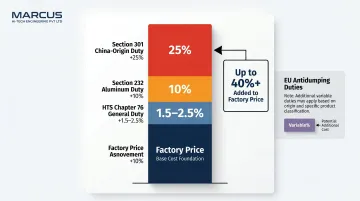
Freight volatility is only one variable. For aluminum extrusions entering the United States, duty obligations stack on top of the factory price:
- General HTS Chapter 76 duty: 1.5–2.5% ad valorem
- Section 232 additional duty on aluminum: 10%
- Section 301 additional duty on many China-origin extrusions: 25%
Combined, these can add 40%+ to the factory price for China-sourced material. The EU has also imposed definitive antidumping duties on aluminum extrusions from China, with rates varying by exporter — meaning landed cost must be calculated per supplier, not assumed from catalog pricing alone.
How to Estimate the Right Budget for Your Custom Extrusion Project
Smart budgeting for custom extrusions starts with defining the full scope before requesting quotes. Don't just specify the profile shape—clarify the alloy, finishing requirements, quality certifications, order volume, and lead time expectations.
Key inputs to gather before requesting a quote:
- Define intended application and load requirements to determine the right alloy and temper (6061-T6 vs. 6063-T5, for example)
- Specify surface finish — mill finish, anodized (clear, color, or hard coat), powder coated, or chemical film
- Provide an annual volume forecast so suppliers can accurately amortize die costs into unit pricing
- Identify compliance or certification needs upfront — IATF 16949 for automotive, AS9100 for aerospace, PPAP, FAIR
- Confirm delivery location, since freight, duties, and landed cost vary significantly by destination
Engage a Manufacturing Partner Early
Working with a partner that offers DFM capabilities, in-house tooling, and integrated machining and finishing surfaces design optimizations that reduce die complexity and downstream costs. Engaging them before the project is finalized gives you the best opportunity to act on those savings. Marcus Hi-Tech Engineering, for example, applies DFM, APQP, and PPAP processes during the quoting phase to help customers across automotive, EV, and industrial sectors identify cost-saving design changes before tooling is committed.
What Most People Get Wrong About Custom Extrusion Costs
Focusing Only on Per-Kg Price
The extrusion material rate is just one line item. Ignoring die cost amortization, finishing, machining, and logistics leads to consistent underbudgeting, especially on low-to-medium volume projects. A $3.00/kg extrusion might look attractive until you factor in the full picture:
- $0.50/kg for anodizing
- $0.80/kg for CNC machining
- $0.40/kg for die amortization on a small run
- Up to 40% added cost from duties and freight
Skipping DFM and Over-Specifying the Profile
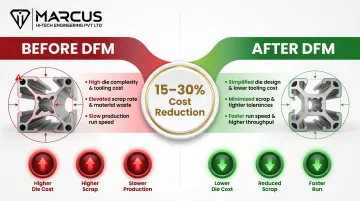
Engineers often carry over conservative or unnecessarily complex geometries from prior designs—features that drive up tooling and machining costs without adding functional value. A DFM review typically identifies simplifications that reduce cost 15–30% by eliminating hollow voids, reducing CCD, or balancing wall thickness.
Choosing the Lowest-Quoted Supplier Without Evaluating Total Landed Cost
Design decisions affect more than tooling—they shape your supplier options and total cost exposure. A lower per-kg rate from a distant supplier can be offset or exceeded by higher shipping, import duties, longer lead times, quality rework costs, and lack of local engineering support.
US trade remedies on aluminum extrusions from multiple countries carry substantial AD and CVD rates, which can push landed costs well beyond the base per-kg quote. Add volatile container shipping rates and compliance costs, and the gap between quoted price and total landed cost can exceed 50%.
Frequently Asked Questions
How much do custom aluminum extrusions cost?
Custom extrusion pricing is not fixed and varies by alloy, complexity, volume, and finishing. Standard 6063 profiles range from $2.50–$3.80/kg, while premium 6061 alloys run $4.00–$6.00/kg. Tooling is a separate one-time cost of $300–$5,000+ depending on die complexity. Refer to the pricing overview section for detailed ranges.
How much does aluminum extrusion cost per foot?
Per-foot pricing for standard versus custom profiles depends on cross-sectional weight, alloy, and finish. Retail pricing for common T-slot profiles shows ranges of approximately $0.86–$1.04 per foot for standard 6063 extrusions. Custom profiles are typically quoted per pound or kilogram, then converted based on linear density.
How much is a custom extrusion die?
Custom extrusion dies range from $300–$800 for simple solid profiles, $800–$2,000 for single hollow designs, and $2,000–$5,000+ for complex multi-void or large-section profiles. This one-time cost amortizes across production volume, so per-unit economics improve significantly at higher run quantities.
Why is aluminum extrusion so expensive?
Three factors drive the cost: volatile raw aluminum prices (currently $2,800–$3,400/MT on the LME), custom tooling requirements ($300–$5,000+ per die), and secondary operations such as finishing and machining. The impact is most pronounced on low-volume or first-run orders, where tooling cost per unit is highest.
What is a cheaper alternative to aluminum extrusion?
Alternatives include roll forming for simpler cross-sections, CNC machining from billet for very low volumes or highly complex geometries, or using standard off-the-shelf profiles when design flexibility allows. Each trade-off involves either higher per-part cost (machining), lower design flexibility (standard profiles), or higher tooling investment (roll forming).
What is the price of 4040 aluminum extrusion?
Standard 40mm × 40mm T-slot profiles with existing tooling, such as 80/20 Inc.'s 40-4040 in 6063-T6 clear anodize, list at approximately $0.044 per millimeter—equaling roughly $44.10 per meter or $13.44 per foot. This reflects a standard modular framing product with existing tooling; custom extrusion pricing will differ based on geometry, alloy, and volume.
Ready to get an accurate quote for your custom aluminum extrusion project? Define your alloy, geometry, volume, and finishing requirements, and work with a manufacturer like Marcus Hi-Tech Engineering that brings DFM expertise, in-house tooling, CNC machining, and surface finishing together to reduce your total project cost.